“Digital credential” is an umbrella term that covers a lot of different artifacts: certificates of completion, professional badges, regulated licenses, blockchain-anchored proofs, signed transcripts. Each has a distinct shape, a distinct verification model, and a distinct set of trade-offs.
This article maps the territory.
The taxonomy
For practical purposes, here is how the credential types decompose:
| Type | Typical issuer | Verification model | Format |
|---|---|---|---|
| Paper certificate | Anyone | Visual inspection only | Printed paper or PDF |
| Hosted digital badge | Badging platform | Lookup against vendor’s site | Proprietary JSON |
| OpenBadges 2.0 badge | Educational organization | Hosted JSON document | OB 2.0 JSON-LD |
| W3C Verifiable Credential | Any issuer | Cryptographic, decentralized | W3C VC JSON-LD |
| OpenBadges 3.0 badge | Educational organization | Cryptographic, decentralized | OB 3.0 = W3C VC profile |
| Blockchain-anchored credential | Any issuer | Cryptographic + chain timestamp | W3C VC + chain anchor |
| Regulated license | Government or licensing body | Authority of the issuing body | Varies by jurisdiction |
The verification model column is the column that actually matters. It tells you whether the credential’s truth depends on the issuer’s infrastructure staying up, on a vendor staying agreeable, or on cryptography that does not need either.
Paper certificates and PDFs
The legacy form. A printed certificate or a PDF with a signature image.
Verification. Visual inspection. The recipient shows the certificate; whoever is looking at it decides whether they believe it. No mathematical proof.
Strengths. Universal in the sense that anyone can produce one and most people accept them at face value. Familiar to recipients.
Weaknesses. Trivially forged. A passable certificate can be produced in twenty minutes with a competent design tool. Cannot be transmitted electronically with any preserved proof of origin. Cannot be partially disclosed (you can show the whole certificate or none of it).
When to use. When the verification stakes are low and the audience is human. A workshop attendance certificate handed out at the end of a one-day event might be paper without much loss.
Hosted digital badges
The first wave of digital credentialing, exemplified by the proprietary formats used by major badging platforms.
Verification. Lookup against the vendor’s website. The badge URL is the proof.
Strengths. Visually appealing. Shareable to LinkedIn. Tracked at the platform level.
Weaknesses. Verification depends on the platform staying online and agreeable. The badge has no off-ramp: move to a different platform and the badge breaks. Recipients do not own the badge in any practical sense; the platform does.
When to use. When you are committed to a specific platform and the credential’s value is roughly contemporary (the badge has value while it is recent; it does not need to verify ten years from now).
OpenBadges 2.0
A proper open specification (1EdTech) with structured metadata, evidence, and alignment to learning frameworks.
Verification. Fetching a hosted JSON document from the issuer’s URL and checking that the issuer matches.
Strengths. Genuinely open. Multiple vendors can issue compatible 2.0 badges. Better metadata than proprietary badges.
Weaknesses. Verification still depends on the JSON document being hosted somewhere reachable. If the issuer’s hosting goes down, verification breaks.
When to use. Where 2.0 is required for ecosystem compatibility (some integrations only accept 2.0 today) but moving to 3.0 should be the default for new issuance.
W3C Verifiable Credentials and OpenBadges 3.0
The current standard. A credential is a structured JSON document with a cryptographic signature. The signature is the verification mechanism; the document does not need to be hosted by the issuer for verification to work.
OpenBadges 3.0 is a profile of W3C VCs for the badge use case. Issuing an OB 3.0 badge means issuing a VC.
Verification. Cryptographic. Any compliant verifier can check the signature against the issuer’s published public key.
Strengths. Recipient-owned, vendor-agnostic, verifiable indefinitely without any specific platform. Standards-compliant by design.
Weaknesses. Adoption is still catching up. Some legacy systems do not yet accept VCs and need a 2.0 or proprietary equivalent.
When to use. Default for all new credentialing programs. Anything you want to still be verifiable in five years should be a VC.
For deeper detail, read What are verifiable credentials? and OpenBadges 3.0 explained.
Blockchain-anchored credentials
A W3C VC where, in addition to the issuer’s cryptographic signature, a hash of the credential is recorded on a public blockchain at the time of issuance.
Verification. Standard VC verification, plus an additional check that the credential’s hash appears on the chain at or before the claimed issuance date.
Strengths. Adds protection against a specific failure mode: the issuer themselves later trying to rewrite history (claiming a credential was issued at a different time, or that a credential was never issued). The chain anchor is independent of the issuer.
Weaknesses. Adds cost (chain transaction fee) and operational complexity. Not necessary unless the use case actually has a threat model where the issuer might be adversarial against their own historical issuance.
When to use. High-stakes credentials where the issuance timestamp must be independently verifiable. Legal credentials, financial certifications, credentials that may be entered in evidence in a regulatory proceeding.
Credostar offers a Blockchain credential tier for this case.
Regulated licenses
Government-issued or licensing-body-issued credentials carrying legal authority. A medical license, an engineering registration, a real-estate license.
Verification. The authority of the issuing body, typically supported by a public registry the body maintains.
Strengths. Carry legal weight. Regulated by law.
Weaknesses. Format and verification mechanism vary widely by jurisdiction. Often paper or PDF, with no cryptographic proof, despite the high stakes.
When to use. When you are the licensing authority. Increasingly, licensing bodies are issuing their credentials as W3C VCs to add cryptographic verifiability on top of the regulatory authority.
Picking the right type
A simple decision tree:
- Will this credential matter in five years? If no, paper or hosted-badge is fine. If yes, use a W3C VC (OpenBadges 3.0 if it is a badge).
- Will an external party need to verify it independently of you? If yes, W3C VC. If no, almost any format works.
- Is the issuance timestamp itself adversarial? If yes (the issuer might later disavow the credential), use a blockchain-anchored VC. If no, standard cryptographic VC is sufficient.
- Does this credential carry legal authority? If yes, you are issuing as a licensing body and the credential’s authority comes from that, not from the format. But you should still use a W3C VC so the credential is independently verifiable.
For most modern credentialing use cases, the answer comes back to W3C Verifiable Credentials. Standard ones for typical use, blockchain-anchored for the high-stakes case.
How Credostar handles each
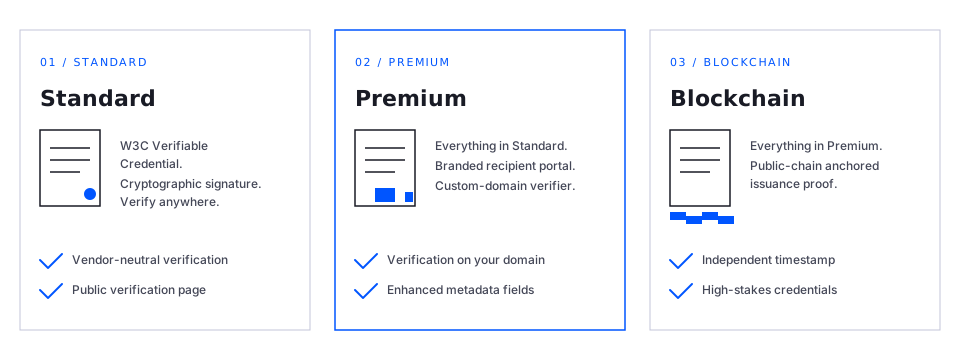
Credostar issues every credential as a W3C VC by default. Three tiers are available:
- Standard. W3C VC with cryptographic signature. Suitable for the vast majority of credentialing use cases.
- Premium. Standard VC plus enhanced metadata, custom verification page, branded recipient portal.
- Blockchain. Standard VC plus public-chain anchoring. For credentials where independent timestamp verification matters.
All three tiers verify as W3C VCs through any compliant verifier. The tier choice is about additional features, not about the format of the credential.
Where to go next
If you are still building intuition for what a VC is, start with What are verifiable credentials?. If you specifically issue badges, read OpenBadges 3.0 explained. If you are weighing the migration from paper, read Digital vs paper credentials.
Ready to issue credentials? Apply for early access to the Credostar Design Partner Program.